
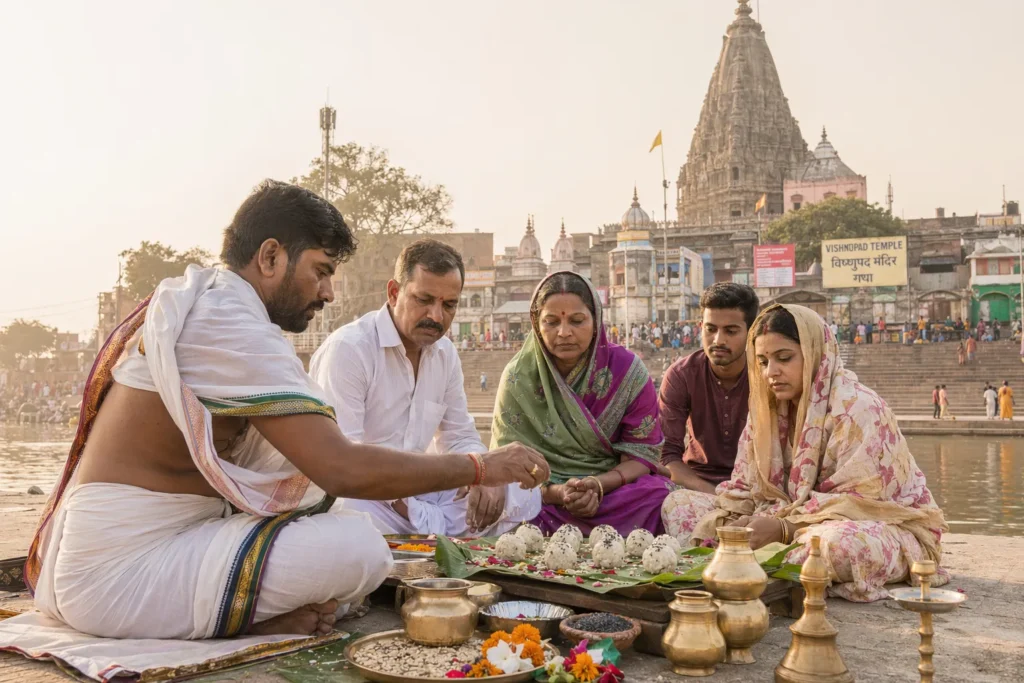
Pind Daan in Gaya: Gaya, the sacred land of Bihar, is regarded as the Pitru Moksha Dham — the one place where performing Pind Daan is believed to liberate the souls of seven previous generations. If you are a South Indian pilgrim seeking an experienced Purohit who speaks your language and follows your traditions, you have found the right team.
What is Pind Daan in Gaya? Meaning & Significance
Pind Daan (also written as Pinda Daan or Pindadanam) is one of the most sacred Shodasha Samskaras in Hinduism. In this ritual, a family member offers pind — round balls made from cooked rice, barley flour, black sesame seeds (til), and ghee — to the souls of departed ancestors, along with water and prayers.
The word Pinda symbolises the physical body and its continuation into the spiritual realm. By offering pind, the living family repays Pitru Rin — the sacred debt owed to ancestors — and helps their souls attain Moksha (liberation from the cycle of rebirth).
According to the Garuda Purana and Vayu Purana, Gaya is the single most powerful place on earth for this ritual. Performing Pind Daan at Gaya is believed to grant liberation to ancestors who could not otherwise attain Moksha — including those who died untimely deaths or carry unresolved karma.
Why is Gaya the Most Sacred Place for Pind Daan?
Gaya in Bihar is not simply a location — it is a tirtha (sacred crossing point) ordained by the scriptures themselves. Several reasons make Pind Daan in Gaya uniquely powerful:
- Lord Rama’s Legacy: According to the Ramayana, Lord Ram, Goddess Sita, and Lakshman came to Gaya to perform Pind Daan for King Dasharatha on the banks of the Falgu River. The ground you walk upon is the same sacred land.
- Vishnu’s Presence: Lord Vishnu himself is believed to reside in Gaya in the form of Gadadhara. The Vishnupad Temple enshrines his actual footprint. Offerings made here are received directly by the divine.
- The Gayasur Legend: The mythological asura Gayasur was blessed by Lord Vishnu, and his body became the holy land of Gaya. Every spot in Gaya carries this divine sanction for ancestral rites.
- Seven Generations: The scriptures declare that Pind Daan performed at Gaya liberates the souls of seven previous generations simultaneously — an unmatched spiritual power found nowhere else.
- 43 Sacred Vedis: There are 43 ritual platforms (vedis) in Gaya, each with specific significance, including Vishnupad Temple, Falgu River, Akshayvat Tree, Pretshila Hill, Brahma Kund, Punpun River, Ramkund, and Sitakund.
Sacred Locations for Pind Daan in Gaya
The three main sites where Pind Daan must be performed, in this sequence:
1. Falgu River (Phalgu)
The sacred river where Tarpan and ritual bathing are performed. It is believed that Sita Mata herself performed Pind Daan here for King Dasharatha. The riverbank is the starting point of the ritual.
2. Vishnupad Temple
The heart of all Pind Daan rituals. An 18th-century temple enshrining Lord Vishnu’s 40cm footprint on a rock. Priests perform the core puja and pind offering here. Most spiritually significant vedi.
3. Akshayvat Tree
An ancient, immortal banyan tree — the “Tree of Immortality.” Offerings made here are considered Akshaya (inexhaustible) and never diminish. Final step of the three-site ritual sequence.
4. Pretshila Hill
For souls who died untimely, tragic, or unnatural deaths. A hill offering with special significance for families performing rituals for those who passed due to accidents, illness, or misfortune.
Step-by-Step Procedure: How to Performed in Gaya
Under the guidance of our South Indian Purohit, the complete Pind Daan procedure in Gaya follows these steps:
- Preparation (Poorva Karma): Take a ritual bath early morning. Wear white or light-coloured traditional clothes (dhoti/kurta for men, light saree or salwar for women). Carry your list of ancestors’ names and Gotra.
- Sankalpa at Falgu River: Your Purohit will perform the Sankalpa (sacred intention-setting), chanting your name, Gotra, and the names of ancestors you are performing the ritual for. This formally initiates the ceremony.
- Tarpan: Offer water mixed with black sesame seeds (til) and sacred kusha grass to your ancestors, reciting each ancestor’s name. This ritual of Tarpan nourishes the souls and prepares them to receive the pind.
- Preparation of Pind: Your Purohit prepares the pind balls from rice flour, barley, sesame, honey, ghee, and tulsi. Each pind represents the body and spirit of a specific ancestor.
- Pind Offering at Vishnupad: Facing south (the direction of Pitrus), place the pind balls on the sacred platform under the direction of your Purohit while he chants Sanskrit mantras. This is the core moment of the ritual.
- Brahmin Bhojan & Dakshina: Offer food and clothing to Brahmins. It is believed the Pitru (soul) is satisfied when Brahmins receive food during Pind Daan. Offer dakshina (donation) with devotion — there is no fixed amount.
- Akshayvat Puja: Proceed to the immortal Akshayvat Tree for final offerings and prayers. Tie a sacred thread around the tree and seek blessings for your family’s prosperity.
- Completion (Uttara Karma): Your Purohit concludes with final mantras and Ashirvad (blessings). You receive confirmation that the ritual is complete and the ancestors’ souls have accepted the offerings.
Pind Daan in Gaya — Packages & Cost 2026
Basic Pind Daan in Gaya
₹5,000–8,000
✓ Core ritual at 3 main vedis
✓ All samagri included
✓ South Indian Purohit
✓ 3–4 hours
MOST POPULAR
Deluxe Pind Daan in Gaya
₹10,000–20,000
✓ 5–7 vedi rituals
✓ Narayan Bali option
✓ Hotel coordination
✓ Station pickup/drop
Premium Pind Daan in Gaya
₹21,000–30,000
✓ Full 43-vedi coverage
✓ Tripindi Shradh included
✓ 3-day ritual program
✓ NRI / proxy available
Note: All packages include samagri. No hidden charges. Dakshina (priest’s donation) is offered as per your wish and devotion — no fixed amount is demanded. Call for a personalised quote.
Why Choose Our South Indian Purohit in Gaya?
We are the only dedicated South Indian Purohit team in Gaya serving Telugu, Tamil, Kannada, and Malayalam-speaking pilgrims. Here is why thousands of South Indian families choose us for Pind Daan in Gaya:
- Rituals in your language — mantras and explanations in Telugu, Tamil, Kannada, or Malayalam
- South Indian Vedic tradition — we follow your regional customs, Gotra lineage, and ritual variations
- 15+ years of experience serving South Indian jajmans at Gaya’s sacred vedis
- Airport and railway station pickup available from Gaya Airport and Gaya Junction
- Accommodation assistance — we coordinate with South Indian dharmashalas and hotels in Gaya
- NRI service — online/proxy Pind Daan with live video streaming and prasad delivery worldwide
- No touts, no pressure, no hidden fees — transparent, devotion-first service
When to Perform Pind Daan in Gaya — Auspicious Dates 2026
While Pind Daan can be performed any day of the year in Gaya, the following times are especially auspicious:
- Pitru Paksha 2026 (Most Important): Sat, 26 Sept, 2026 – Sat, 10 Oct, 2026 -the 16-day ancestral fortnight when 10–20 lakh pilgrims visit Gaya. Book early to secure your Purohit and accommodation.
- Death Anniversary (Tithi): The exact lunar date of an ancestor’s death is a highly auspicious time to perform Pind Daan.
- Amavasya (New Moon): Every monthly new moon day is sacred for ancestor rituals.
- Mahalaya Amavasya: The last day of Pitru Paksha — the single most powerful day for Pind Daan in the year.
- Gaya Tritiya & other special tithis: Ask our Purohit for guidance on your specific family’s most auspicious date.
Also Check : Best Shradh Pandit In gaya ji
Frequently Asked Questions — Pind Daan in Gaya
Q1. What is Pind Daan in Gaya and why is Gaya special for this ritual?
Ans: Pind Daan in Gaya is the offering of sacred rice balls (pind) to departed ancestors at holy sites like Vishnupad Temple, Falgu River, and Akshayvat. Gaya is the most powerful place for this ritual because it is mentioned in the Garuda Purana and Vayu Purana as the Pitru Moksha Dham — where Lord Vishnu himself resides and blesses the souls. A single Pind Daan at Gaya is believed to liberate the souls of seven previous generations.
Q2. When is Pitru Paksha 2025 in Gaya and when should I book?
Ans: Pitru Paksha 2025 in Gaya runs from September 6 to September 21, 2025, with the Pitripaksh Mela officially from September 6 to September 21. This is the most auspicious time, and Gaya sees 10–15 lakh pilgrims during this period. Book your South Indian Purohit and accommodation at least 4–6 weeks in advance to avoid unavailability.
Q3. What is the cost of Pind Daan in Gaya in 2026?
The cost ranges from ₹5,000 (basic single-day ritual at 3 vedis) to ₹30,000 (premium 3-day program with all 43 vedis, accommodation, and additional rituals). All our packages include samagri and a dedicated South Indian Purohit. Dakshina is offered as per your own wish — we never demand a fixed amount.
Q4. Can daughters or women perform Pind Daan in Gaya?
Ans: Yes. Women can fully and equally participate in Pind Daan at Gaya. This is supported by the example of Sita Mata, who performed Pind Daan for King Dasharatha at Falgu River. Today, daughters, wives, and mothers commonly perform the ritual alongside male family members, and in some families, as the sole performer.
Q5. Can NRIs perform Pind Daan in Gaya without being physically present?
Ans: Yes. We offer proxy Pind Daan in Gaya for NRIs with live video streaming via WhatsApp or Zoom. Your family’s ancestors’ names and Gotra are used. Prasad and ritual photographs are dispatched to your address. Contact us on +91-6202749416 to book an NRI Pind Daan slot.
Q6. How many days should I plan for Pind Daan in Gaya?
Ans: A single-day Pind Daan at the three main sites (Falgu River, Vishnupad Temple, Akshayvat) takes 3–4 hours. Plan to arrive the previous evening for ritual preparation. For comprehensive coverage of multiple vedis, plan 2–3 days. During Pitru Paksha, many South Indian families stay for the full 16 days.
Q7. What samagri (ritual items) do I need to bring for Pind Daan in Gaya?
Ans: You don’t need to bring anything. Our South Indian Purohit team arranges all samagri: cooked rice, barley flour, black sesame, ghee, honey, tulsi, holy water, flowers, and incense. Simply bring: your ancestors’ names (written in your language), their Gotra, the date of passing, white or light-coloured traditional clothes, and your faith.
Q8. What is the difference between Pind Daan, Shradh, and Tarpan?
Ans: These are three components of the same ancestral ritual: Tarpan is the offering of water mixed with sesame seeds to nourish the ancestors’ souls; Pind Daan is the offering of rice ball food to provide the soul with a spiritual body; Shradh is the broader annual ceremony that includes Pind Daan, Tarpan, and Brahmin bhojan (feeding of priests). All three are performed together at Gaya for complete ancestral liberation.
